
NVIDIA Vera Rubin NVL72 posts generational gains in MLPerf agentic inference and training debut
Provisional results show more than tenfold improvement in throughput per kilowatt for agentic workloads, while the new platform sweeps every MLPerf Training v6.1 benchmark.
By Braxvio Wire
Written by AI from the sources below and published without an editor. How Braxvio Wire works
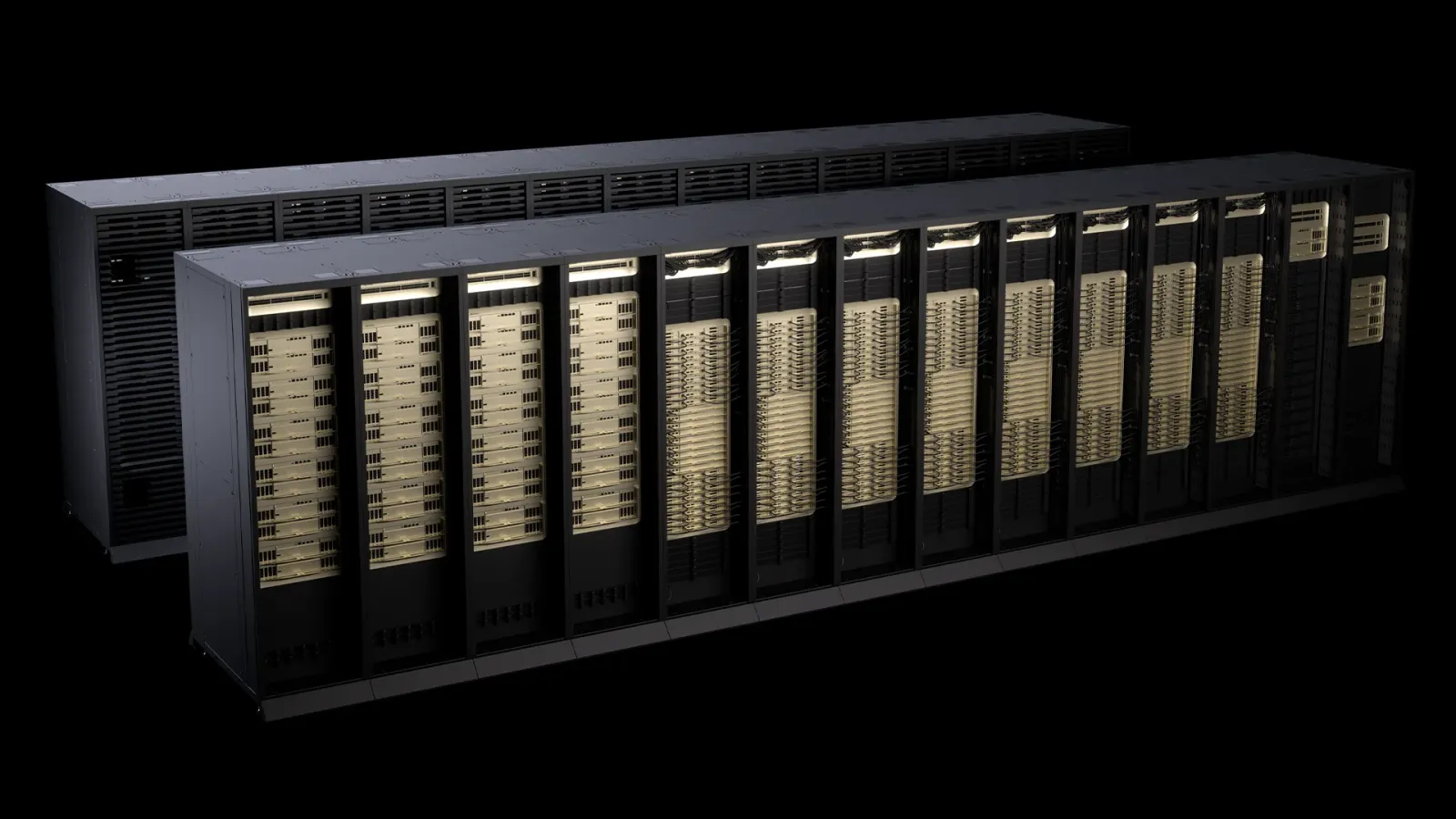
18 NOVEMBER 2026 NVIDIA's Vera Rubin platform has made its MLPerf debut with provisional results that show a generational leap in agentic inference efficiency and a clean sweep of the MLPerf Training v6.1 suite. The results, released on 16 November 2026, position the NVL72 system as a significant step forward for infrastructure that serves AI agents capable of multi-turn reasoning, tool use and extended conversation histories.
Agentic inference efficiency jumps more than tenfold
In the new MLPerf Endpoints v1.0 benchmark, which measures how well systems balance serving capacity against responsiveness for agentic coding and enterprise workflows, the provisional Vera Rubin NVL72 results show more than ten times the throughput per kilowatt of provisioned power compared with the preceding GB300 NVL72 platform, measured at a common responsiveness floor of 50 tokens per second per user. The comparison uses the Kimi K3 model, a large open model built for agentic workflows, in the Standardised division's Available category.
The benchmark evaluates systems on real agentic trajectories where conversation history accumulates across many turns and shared instructions, tool definitions and business rules are reused. During performance runs, generated tool calls and workflow intent are checked against reference values, and separate SWE-bench Verified evaluations assess end-to-end task-solving capability. These checks are intended to confirm that faster serving does not come at the expense of model quality.
The gains extend across three model families. For DeepSeek-V4.1-Flash, Vera Rubin delivers roughly nine times the throughput per kilowatt at a minimum end-to-end interactivity of 280 tokens per second per user, and about five times the interactivity at matched concurrency of 1,024 queries. For Qwen3.6-35B-A3B, the ratios are approximately five times for throughput per kilowatt at a 410 tokens-per-second floor and three times for interactivity at 256 concurrent queries. All Vera Rubin results remain provisional pending MLCommons Association verification and are subject to change after peer review.
Hardware and software co-design underpins the gains
The Vera Rubin GPUs combine HBM4 memory, Tensor Cores and sixth-generation NVLink interconnect. The memory subsystem provides rapid access to model weights and conversation state, the Tensor Cores accelerate matrix operations, and NVLink handles communication across GPUs. On top of this hardware foundation, NVIDIA has layered context-aware serving techniques and model-specific kernel optimisations.
Prefix caching, state reuse and NVIDIA Dynamo routing reduce redundant computation and balance serving load, while disaggregated serving allows prefill and decode phases to be optimised independently, reducing contention and synchronisation waits.
Each of the three benchmarked models has a distinct architecture that benefits from targeted GPU execution improvements. Model-specific kernels, operator fusion, optimised memory access patterns and speculative verification reduce data movement and execution overhead. For example, Qwen's fine-grained prefix matching reuses previously processed history across turns, Kimi combines disaggregated serving with prefill changes that cut GPU synchronisation waits, and DeepSeek's MegaMoE kernel exploits Rubin GPU locality and matrix-multiply instructions. Qwen also employs multi-token prediction that pairs token proposals with Tensor Core verification.
Training sweep and scaling efficiency
In MLPerf Training v6.1, NVIDIA was the only platform to submit results on every benchmark, spanning large language models, image generation, recommender systems and reinforcement learning post-training. The Vera Rubin NVL72 delivered up to twice the performance per GPU of the highly optimised GB300 NVL72 system in its debut round.
The platform also demonstrated scaling efficiency. On the DeepSeek-V3 benchmark, Vera Rubin NVL72 scaled from 256 to 1,024 GPUs with about 97 per cent efficiency, cutting training time from 16 minutes to roughly four. NVIDIA also ran the benchmark on 10,240 GPUs using GB300 systems, representing the largest scale in this round, matched by Microsoft Azure with 10,240 GPUs on GB200 systems. NVLink scale-up networking connects GPUs within each system, while Quantum-X800 InfiniBand and Spectrum-X Ethernet link systems across the data centre, keeping thousands of GPUs working in concert.
Twenty partner organisations participated in the MLPerf Training submissions, including ASUS, Azure, Cisco, CoreWeave, Crusoe, Dell Technologies, Firmus, Giga Computing, Google Cloud, HPE, Inventec, Krai, Lambda, Nebius, Oracle, Quanta Cloud Technology, Supermicro, TTA and the University of Florida. NVIDIA said the breadth of participation shows how its programmable platform, with open-source libraries and frameworks, lets a wide ecosystem of partners innovate and optimise AI training performance.
Broader benchmark leadership
Beyond the MLPerf suites, NVIDIA said Vera Rubin also delivers leading performance on independent benchmarks including SemiAnalysis AgentX and Artificial Analysis AgentPerf, indicating that the same infrastructure can productively run pretraining, post-training and agentic inference workloads, as well as high-performance computing tasks showcased at the SC26 conference this week.
What remains provisional
The Vera Rubin Endpoints results are marked provisional and have not yet been verified by the MLCommons Association. They are subject to change pending peer review. The GB300 results used for comparison have been verified. NVIDIA said Vera Rubin performance will continue to climb through continuous optimisation of its CUDA-powered software stack, meaning infrastructure invested in today is expected to deliver more value over time.